As we have a MD trajectory of multiple
Again, with the MD trajectory, the van hove function can easily be generated with the following command:
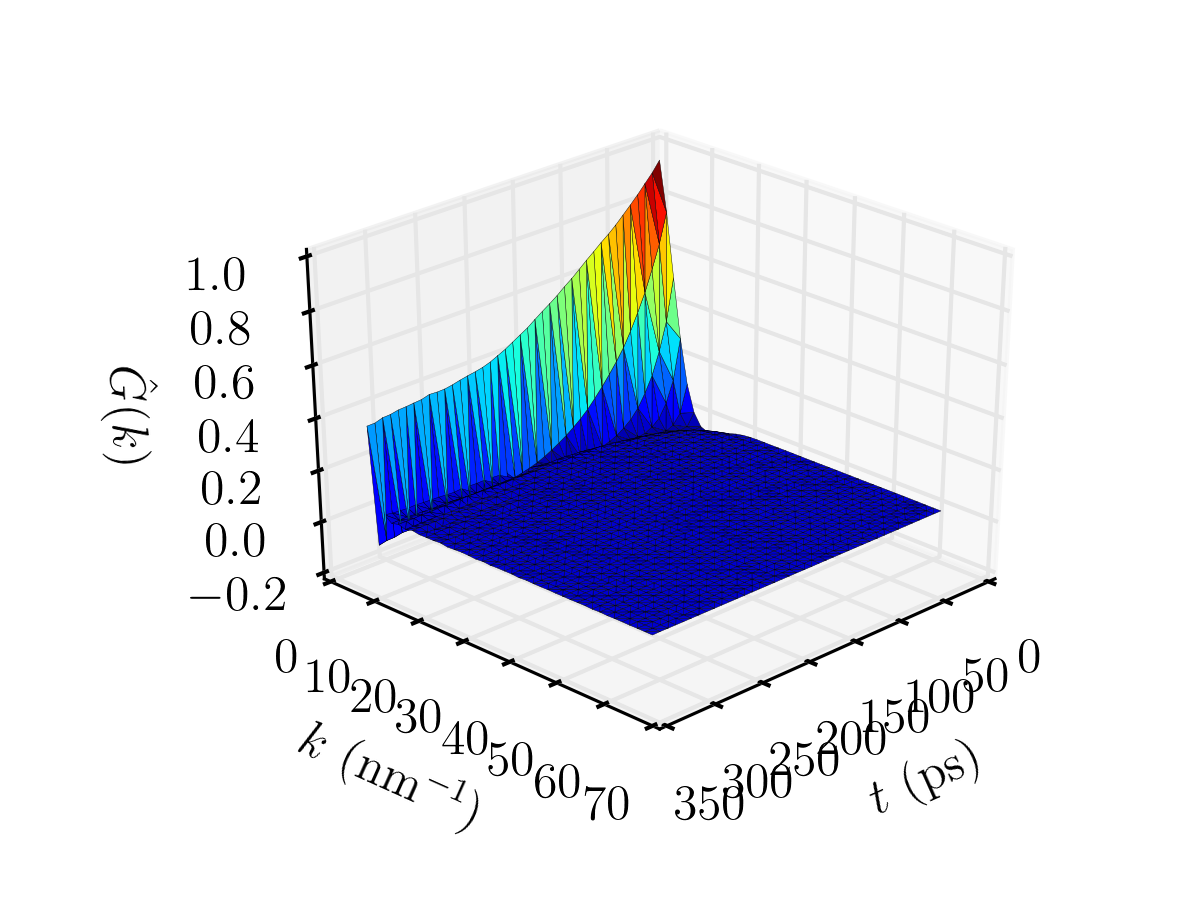
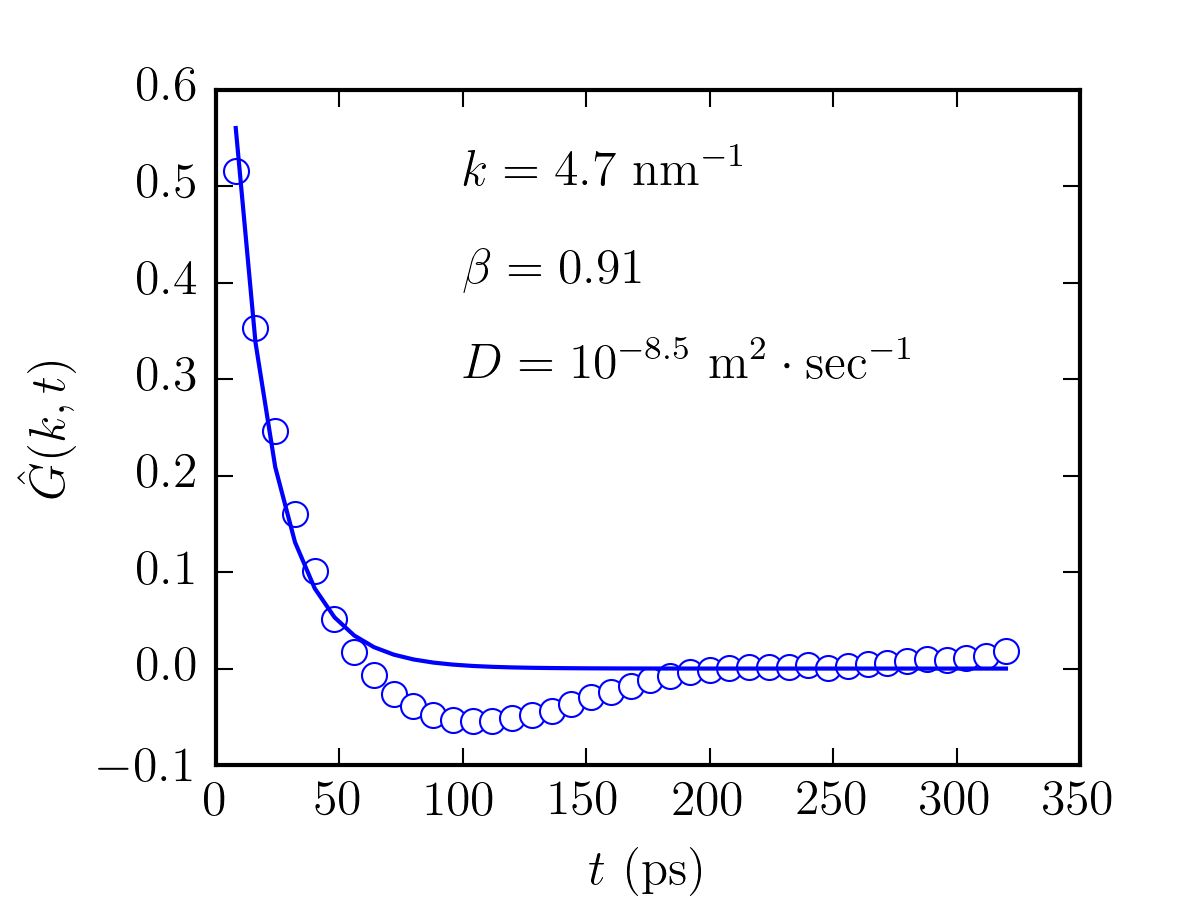
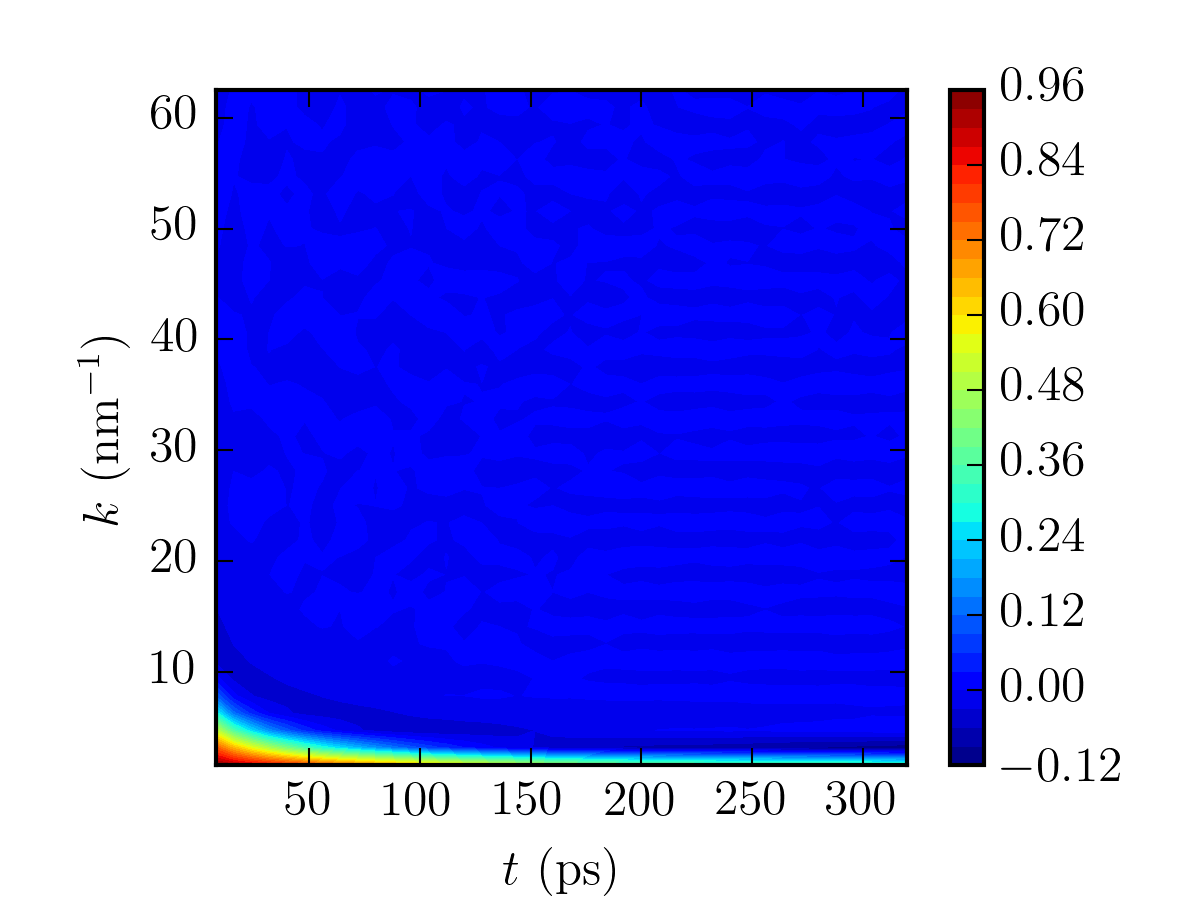
A contour plot and a 3D plot are generated as belows. Again, for benzene rings, as $k$ is small, it takes a longer time for the structure factor to decay to zero, and vice and versa for larger value of $k$. The 3D plot also makes this more obvious. At $k=4.7~\mathrm{nm^{-1}}$, $\hat{G}(k,t)$ is fitted to a stretched exponential function with the following form: \begin{equation} \exp\Big[-(k^2Dt)^{\beta}\Big] \end{equation} where $\beta$ is an indication of the non-linearity of the system, i.e. the lower the value of $\beta$, the higher the non-linearity of the system. In this case, it was found that $\beta=0.91$ and $D=10^{-8.5}~\mathrm{m^2\cdot sec^{-1}}$. The calculated value of diffusivity in this example is in agreement with that of the experimental value, which should be around $10^{-8.6}~\mathrm{m^2\cdot sec^{-1}}$ at $300$K. To reiterate, the dynamic structure factor, which is expressed as $\hat{G}(k,t)=\hat{S}(k,t)=\hat{\omega}(k,t)+\rho\hat{h}(k,t)$, consists of the intramolecular ($\hat{\omega}(k,t)$) and intermolecular ($\hat{h}(k,t)$) part.