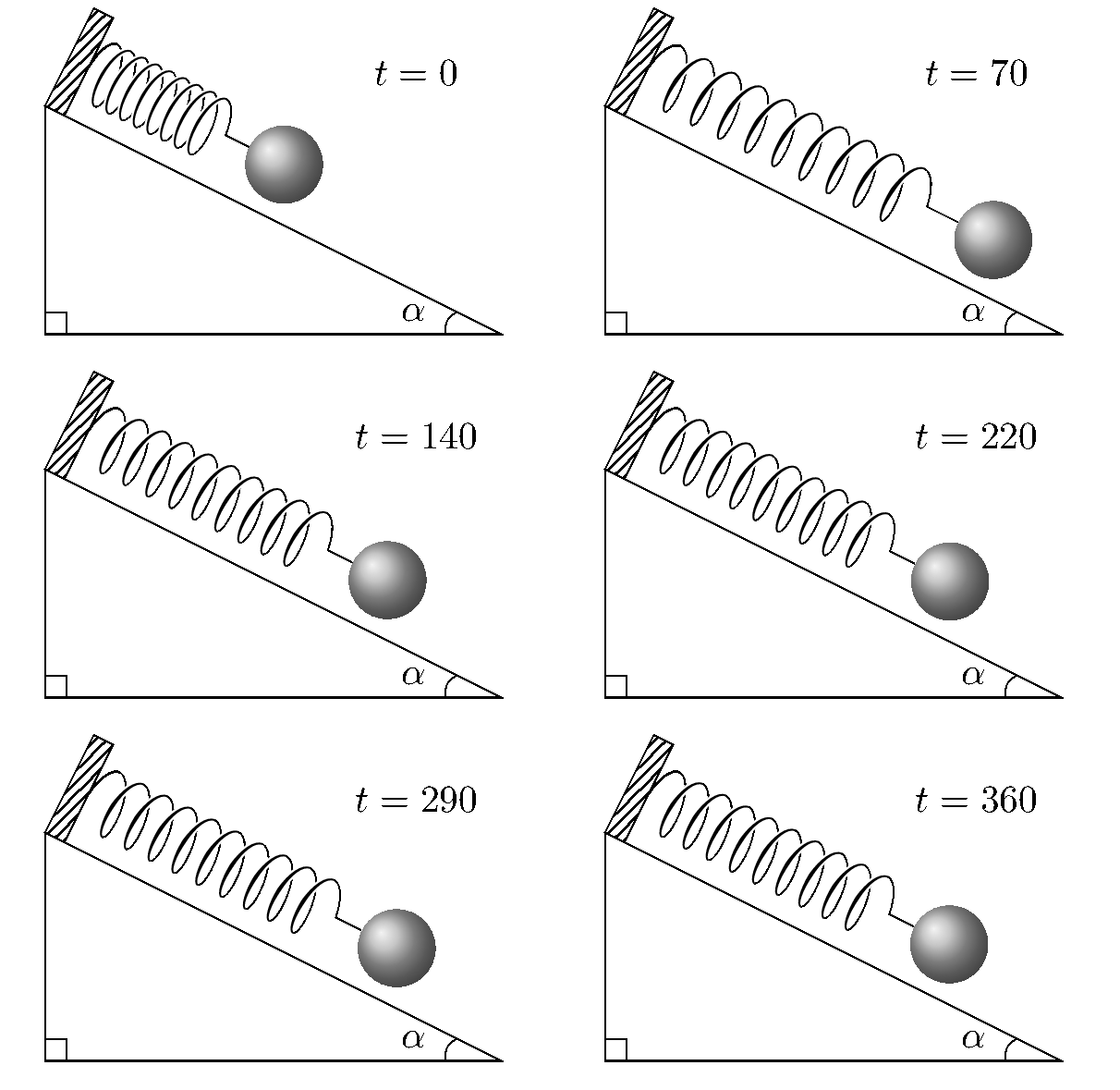
The friction can also be considered in the case of a tilted oscillator. We can incorporate such effect through the damping term in the equation of motion:
\begin{align}
\frac{d^2r}{dt^2}+\underline{\frac{\zeta}{m}\frac{dr}{dt}}=-\frac{k}{m}r+\frac{k}{m}L+g\sin\alpha
\end{align}
Laplace transformation allows us to write the following:
\begin{align}
(s^2+\frac{\zeta}{m}s+\frac{k}{m})R(s)-(s+\frac{\zeta}{m})r(0)=\frac{1}{s}(\frac{k}{m}L+g\sin\alpha)
\end{align}
We then need to apply inverse laplace transformation in the following:
\begin{align}
R(s)=\frac{s+\frac{\zeta}{m}}{s^2+\frac{\zeta}{m}s+\frac{k}{m}}\Big(r(0)-L-\frac{mg\sin\alpha}{k}\Big)+\frac{1}{s}\Big(L+\frac{mg\sin\alpha}{k}\Big)
\end{align}
This leads to the following:
\begin{align}
r(t)=\Big(r(0)-L-\frac{mg\sin\alpha}{k}\Big)e^{-\frac{\zeta}{2m}t}\Big[\cos(\sqrt{\frac{k}{m}-\frac{\zeta^2}{4m^2}}t)+\frac{\zeta}{2m}\sin(\sqrt{\frac{k}{m}-\frac{\zeta^2}{4m^2}}t)\Big]+L+\frac{mg\sin\alpha}{k}
\end{align}