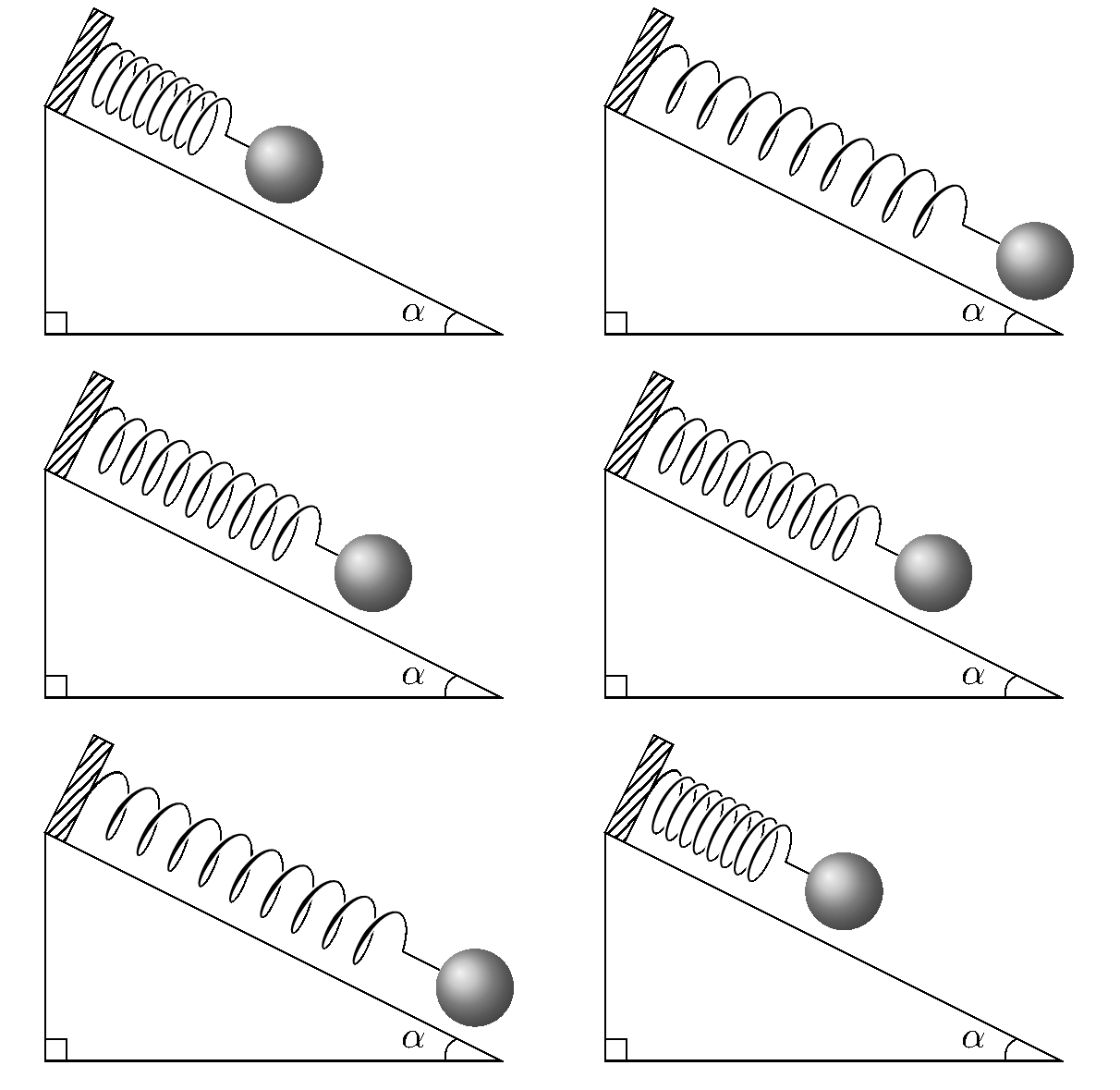
A tilted oscillator is a 2D problem as depicted in Figure 1. As shown in Figure 1, the spring with spring constant $k$ is in an equilibrium position when $(x,y)=(L_x,L_y)$. The equilibrium length of the spring is $L$. Then, we can write the equations of motion as:
\begin{align}
m\frac{d^2x}{dt^2}&=-k(x-L_x)\\
m\frac{d^2y}{dt^2}&=-k(y-L_y)+mg
\end{align}
where $m$ is the mass and $g$ is the gravitational acceleration. Transformation from Cartesian into polar coordinates that $x=r\cos\alpha$ and $y=r\sin\alpha$ results in the following second time derivatives:
\begin{align}
\frac{d^2x}{dt^2}&=-r\sin\alpha\frac{d^2\alpha}{dt^2}-r\cos\alpha\Big(\frac{d\alpha}{dt}\Big)^2-2\sin\alpha\frac{d\alpha}{dt}\frac{dr}{dt}+\cos\alpha\frac{d^2r}{dt^2}\\
\frac{d^2y}{dt^2}&=r\cos\alpha\frac{d^2\alpha}{dt^2}-r\sin\alpha\Big(\frac{d\alpha}{dt}\Big)^2+2\cos\alpha\frac{d\alpha}{dt}\frac{dr}{dt}+\sin\alpha\frac{d^2r}{dt^2}\\
\end{align}
In this example of a tilted oscillator, $\alpha$ is a constant that never changes with time. Hence the equation of motion in polar coordinate:
\begin{align}
\cos\alpha\frac{d^2r}{dt^2}&=-\frac{k}{m}(r\cos\alpha-L_x)\\
\sin\alpha\frac{d^2r}{dt^2}&=-\frac{k}{m}(r\sin\alpha-L_y)+mg
\end{align}
This can be combined into one single equation:
\begin{align}
\frac{d^2r}{dt^2}&=-\frac{k}{m}[r-(L_x\cos\alpha+L_y\sin\alpha)]+g\sin\alpha
\end{align}
The term $(L_x\cos\alpha+L_y\sin\alpha)=L$, so that:
\begin{align}
\frac{d^2r}{dt^2}&=-\frac{k}{m}r+\frac{k}{m}L+g\sin\alpha
\end{align}
Finally, we arrive at the solution:
\begin{align}
r(t)&=r(0)\cos\Big(\sqrt{\frac{k}{m}}t\Big)+\Big(L+\frac{mg\sin\alpha}{k}\Big)\Big[1-\cos(\sqrt{\frac{k}{m}}t)\Big]
\end{align}
This can be converted back to $x(t)$ and $y(t)$ easily:
\begin{align}
x(t)&=r(0)\cos\alpha\cos\Big(\sqrt{\frac{k}{m}}t\Big)+\Big(L_x+\frac{mg\sin\alpha\cos\alpha}{k}\Big)\Big[1-\cos(\sqrt{\frac{k}{m}}t)\Big]\\
y(t)&=r(0)\sin\alpha\cos\Big(\sqrt{\frac{k}{m}}t\Big)+\Big(L_y+\frac{mg\sin^2\alpha}{k}\Big)\Big[1-\cos(\sqrt{\frac{k}{m}}t)\Big]
\end{align}
The fun part is to visualize the trajectory as an animation.