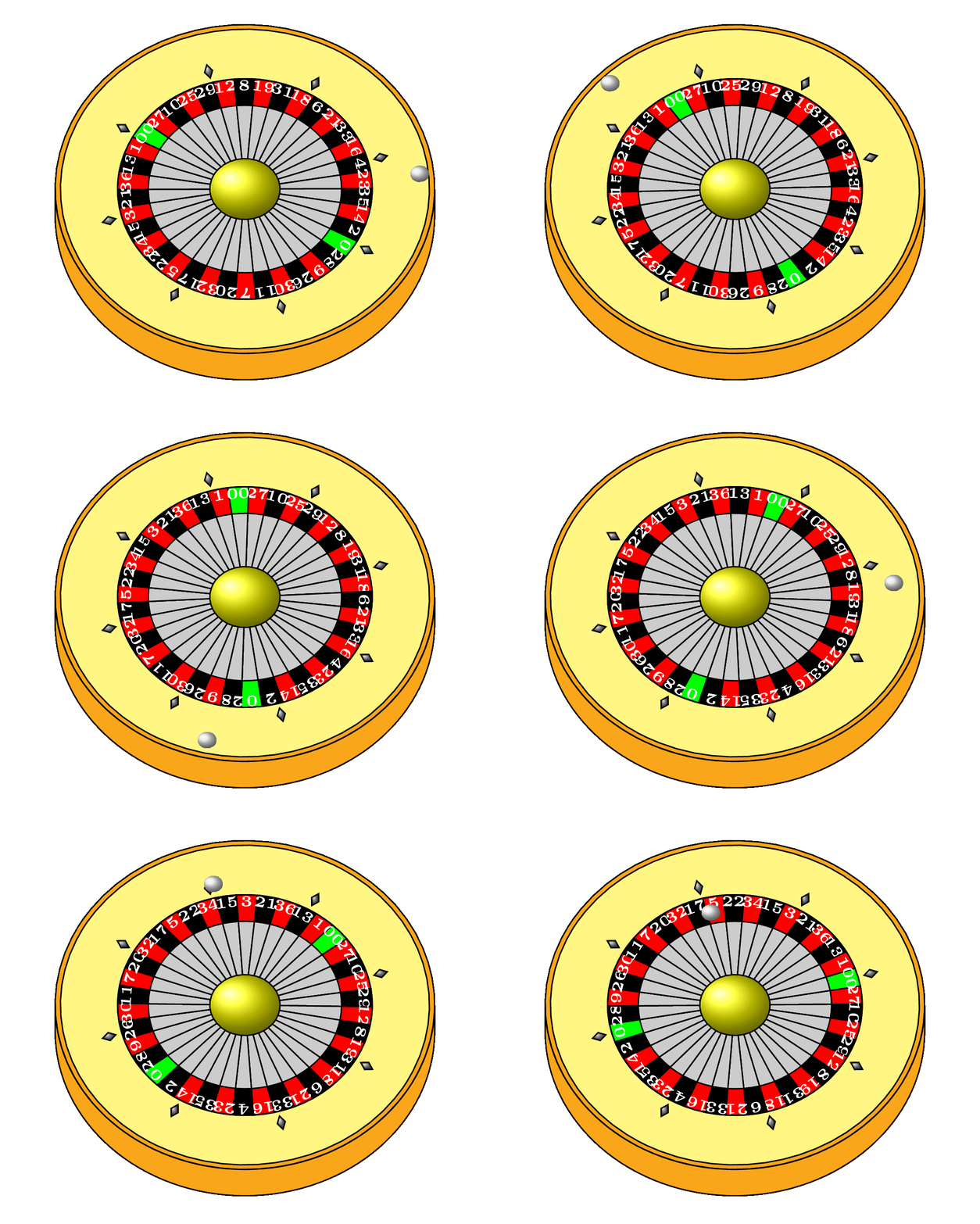
A Preliminary Analysis on Roulette
Similar to the case of a tilted oscillator, the circular motion of the ball within the Roulette wheel can also be described by the equations of motion expressed in terms of the polar coordinates.
\begin{align}
\frac{d^2r}{dt^2}-r\Big(\frac{d\theta}{dt}\Big)^2+\underline{\xi\frac{dr}{dt}}&=-g\tan\alpha\\
r\frac{d^2\theta}{dt^2}+2\frac{dr}{dt}\frac{d\theta}{dt}+\underline{\xi r\frac{d\theta}{dt}}&=0
\end{align}
The underlined terms here in these two equations determine the effect of damping, which is extremely crucial as it can be observed in the casino that the ball must eventually decelerate and the force upon it shall be dominated by gravitational pull alone (i.e. the term $-mg\tan\alpha$, where $\alpha$ describes how tilted is the Roulette wheel with respect to the horizontal surface).
These nonlinear equations of motion can only be solved numerically. Once the ball hits the deflector, the angular velocity becomes zero, that the equation of motion becomes:
\begin{align}
\frac{d^2r}{dt^2}+\xi\frac{dr}{dt}&=-g\tan\alpha
\end{align}
One can find that the final landing position of the ball is determined by the friction coefficient $\xi$ and the initial velocity of the ball.
Figure 1: A period near the end of the simulation run when the force acting upon the ball is dominated by gravitational pull.